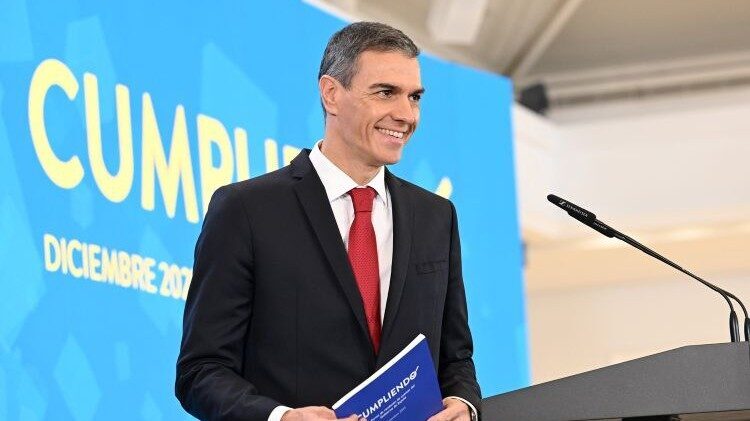
<h6><strong>Eduardo González</strong></h6> <h4><strong>The Prime Minister, Pedro Sánchez, released the government's new “accountability report” for the last six months of the year on Monday, December 15th, highlighting the “implementation of an ambitious foreign policy” based on coherence, multilateralism, and the defense of peace and solidarity.</strong></h4> The government has implemented “an ambitious foreign policy” based on “three principles: coherence in our international action, strengthening multilateralism, and a firm commitment to peace and solidarity,” Sánchez stated at the press conference presenting the report, ‘Delivering,’ which took place at the Moncloa Complex in Madrid. In this regard, the report emphasizes that Spain “has strengthened its position as a leader in the defense of multilateralism, the rules-based international order, and the United Nations peace and security agenda.” “In the last six months of the year,” the document continues, “the Government has approved the Royal Decree-Law confirming the arms embargo on the State of Israel and restricting the transit of goods and products used in the killing of civilians in the Gaza Strip.” Furthermore, “Spain has continued sending humanitarian aid to Gaza, reaching a total of 50 million euros since the conflict began in October 2023,” and the Government “has continued to promote the recognition of the State of Palestine in forums such as the United Nations and the EU and maintains an active diplomatic agenda to achieve a lasting peace solution in the Middle East based on the two-state solution.” This same policy has been applied in Ukraine: with increased economic aid and the opening of the Office for Reconstruction, which looks to the future,” the document continues. “In this line of defense of multilateralism,” the report states, “the Seville International Conference on Financing for Development stands out as the largest multilateral summit in our country in recent decades, and it was a resounding success in terms of participation.” At the meeting, which “brought together representatives from more than 185 countries and 100 international organizations,” the Seville Commitment was adopted by consensus, setting the new international agenda on the matter, and more than 100 concrete initiatives were launched through the Seville Platform for Action. “Finally, Spain has continued to strengthen its relationship with the countries of the Ibero-American community, including Brazil, Colombia, Uruguay, Paraguay, and Chile, with its partners in the Union for the Mediterranean, with the countries of the Sahel and West Africa, and with such important trading partners as the People’s Republic of China, India, and Morocco,” the report concludes. report. <h5><strong>Rest of the report</strong></h5> Furthermore, Sánchez asserted at the press conference that “Spain is progressing well above the European average and is a considerably better country than it was seven years ago: more cohesive, less unequal, more prosperous, growing in a fair manner, and facing present challenges with solutions that point to the future.” According to the Prime Minister, “in this semester, and in a difficult context with the war in Ukraine and the trade wars, Spain has continued to be, as in the previous year, one of the most prosperous economies in the West.” However, he acknowledged that “there is still much to be done” because “there are still too many people living in precarious conditions and with deprivation.” In his appearance, Sánchez affirmed, in relation to the corruption and alleged sexual harassment cases that have come to light in recent days, that “the commitment of the Government and the Socialist Party to feminism is absolute.” “Have we made mistakes? Like everyone. But all the progress made in gender equality has always been achieved under progressive governments,” he added, and therefore, “we have no lessons from those who vote against this progress and appeal it to the Constitutional Court, from those who question violence against women or make deals with those who do,” he declared. “And we have no lessons from those who make pronouncements of exemplary conduct from a headquarters paid for with dirty money,” he continued, referring to corruption. “The Government and my party have acted decisively, not with collusion, with transparency, not with opacity, cooperating with the Justice system and the State Security Forces, and not obstructing their work as happened in the past,” he asserted. “Systemic corruption, the kind that affected the entire democratic system of our country, ended with the People’s Party leaving the Government of Spain,” added Sánchez, who, in his assessment of the first half of the year, recalled the approval of the State Plan to Combat Corruption.