The Diplomat
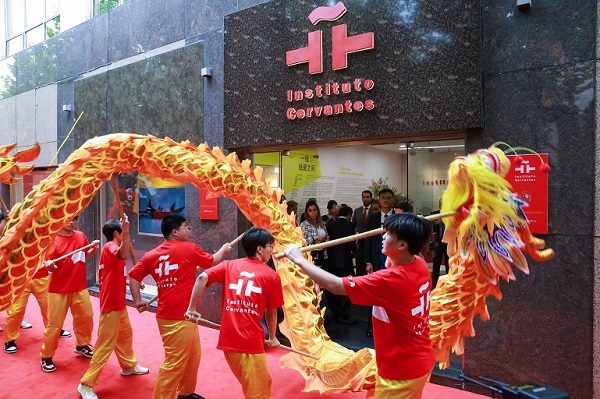
The Cervantes Institute in Shanghai will present next week the third edition of the ‘Catalog of Spanish Literature Translated into Chinese’, a publication that compiles nearly two thousand titles by authors from Spain and Latin America published in China up to August 2025.
The event, which will take place on December 18, will include the director of the Shanghai center, Inma González Puy; the author of the publication, Lucila Carzoglio; the translator Hou Jian; and the editor Peng Lun.
With nearly 250 pages, this publication explores those titles by Spanish-language authors that have found a place in the Chinese publishing world. For example, it shows that the most translated and cited writer is the Argentinian Jorge Luis Borges, whose fortieth death anniversary is next year and whose works are being republished in the Asian country.
Following closely behind is the Colombian Gabriel García Márquez. Both authors influenced not only the publishing world but also Chinese literature, as the impact of the Latin American Boom was “decisive” in China during the 1980s. Another prominent author in this catalog is the Chilean Roberto Bolaño, whose entire body of work has been translated.
Furthermore, between 2020 and August 2025, approximately 350 titles were published for the first time. Andrés Barba, Sara Mesa, Juan Tallón, Benjamín Labatut, Alia Trabucco Zerán, Javier Cercas, María Gainza, Agustina Bazterrica, Cristina Rivera Garza, Fernanda Melchor, Claudia Ulloa Donoso, and Pilar Quintana are some of the authors.
In this case, literature written by women is “setting trends,” with names such as Irene Vallejo, Mariana Enríquez, Samanta Schweblin, Cristina Rivera Garza, Fernanda Melchor, Sara Mesa, and Guadalupe Nettel, among others.
The document also reflects that in the 1950s and 60s, Spanish and Latin American authors whose work resonated with the political context in China, such as Federico García Lorca, Rafael Alberti, Mariano Azuela, Pablo Neruda, César Vallejo, and Miguel Ángel Asturias, began to circulate in local versions. In the early 1980s, a Spanish classic like “El Cantar de mío Cid” was translated, and “El lazarillo de Tormes” was republished.
However, it was the Latin American Boom that truly broke down literary barriers. Between 1979 and 1999, researcher Lou Yu mentions ten editions and three translations of García Márquez’s “One Hundred Years of Solitude”; six editions and three translations of Neruda’s “Confieso que he vivido”; and three editions of Mario Vargas Llosa’s “La casa verde” and “La tía Julia y el escribidor,” among others. Many of these editions had print runs exceeding fifty thousand and even reaching one hundred thousand copies.
The catalogue is being published to coincide with the 110th anniversary of the first recorded translation from Spanish to Chinese. According to researcher Hou Jian, the first translation of a literary work from Spanish was in 1915 with a book whose author was not identified, but which was titled ‘Anecdotes of the Spanish Court’. Separately, the first Chinese version of Don Quixote appeared in 1922, adapted by Lin Shu from an indirect translation from English, and it was a bestseller.
Although print runs are currently smaller than in the 1980s, current translations reach China almost simultaneously with the rest of the world, with print runs typically ranging from 5,000 to 8,000 copies.
“I can’t think of a more solid bridge than translating the literature of a people, a continent, a community of more than 600 million speakers, whose works and reference authors will be known and understood in China, thanks to the talent and effort of the translators who, in an act of pure creation, seek the right and precise word to exchange sensibilities between geographically distant countries, but increasingly united,” declared Luis García Montero, director of the Cervantes Institute, in his prologue.