
Eduardo González
The far-right Vox party attempted to capitalize on a motion by the People’s Parliamentary Group regarding Ceuta and Melilla to promote in the Spanish Parliament “the suspension of the Association Agreement between the EU and Morocco.”
On November 25, the Joint Committee on Insularity of the Senate and the Congress approved a motion from the Popular Parliamentary Group in the Senate urging the Government to “finally develop the Comprehensive Security Plan for the Autonomous Cities of Ceuta and Melilla, as committed to in the 2021 National Security Strategy,” according to this week’s Official Gazette of the Spanish Parliament (BOCG).
The text also urges the Executive to “include in the aforementioned Plan the necessary measures to guarantee the sustainability of the commercial, economic, and social model of the Autonomous Cities and, consequently, the well-being of their citizens” and to “adopt, as a matter of urgency, the measures included in that Plan aimed at alleviating the negative impact that the unilateral decisions of the Moroccan Government and their persistence have on the sustainability of said model.”
An amendment to this motion, presented by Vox but not adopted, called on the Government to “guarantee the application of the Principle of Reciprocity and increase border controls, especially with Morocco, to ensure that imported products comply with EU internal regulations,” and to “promote the suspension of the Association Agreement between the EU and Morocco within European institutions.”
During the defense of the motion, Senator Fernando Gutiérrez Díaz de Otazu, of the People’s Party (PP), stated that Ceuta and Melilla are “two fully Spanish cities located on the African continent, forming the only land border between Spain and the European Union with an African country, and therefore subject to a situation of vulnerability that must be understood by the national community and the General State Administration.”
The PP senator recalled that the last agreement for maintaining good relations and mutual support for the prosperity of the territories on both sides of the border is the Treaty of Friendship, Good Neighborliness and Cooperation signed between Spain and Morocco in 1991. “Spain has always been willing to maintain the good relations established in the aforementioned treaty, which has not always been reciprocated in the same way by Morocco,” but “this last period, which began in 2018 with the arrival of President (Pedro) Sánchez, has been especially negative from this point of view,” he lamented.
Gutiérrez de Otazu also recalled that the National Security Strategy of November 2021 stated that “the Autonomous Cities of Ceuta and Melilla, due to their geographical location on the African continent and the specific nature of their Spanish and European border, require special attention from the General State Administration to guarantee the security and well-being of their citizens” and therefore proposed the development of “a Comprehensive Security Plan for Ceuta and Melilla.”
“Four years have passed since the publication of that 2021 strategy,” he lamented, “and there is no record of the publication of the aforementioned comprehensive security plan for both cities, although, as is often the case in many other matters related to the needs of Ceuta and Melilla, messages of good intentions, requests for patience from the public, and the United Nations’ phrase that ‘we are working on it’ abound in practically every sphere.”
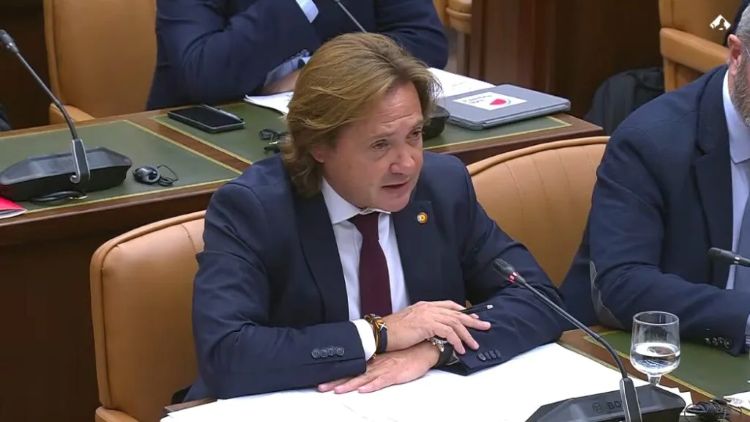
For his part, Jorge Campos, a Vox MP, proposed during the debate “an amendment to ensure that any commercial activity between the kingdoms of Morocco and Spain does not negatively impact the interests of Spanish livestock farmers, agricultural producers, fishermen, and merchants; that is, to guarantee the application of the principle of reciprocity and increase border controls, especially with Morocco, to ensure that imported products comply with European Union regulations.” He also explained that the amendment urged “promoting the suspension of the European Union-Morocco Association Agreement within European institutions.”
Gutiérrez de Otazu expressed his rejection of the amendment, arguing that the motion’s objective “is not to create conflicts or react to Morocco’s unfriendly actions with similar measures,” nor is it “to resolve Spain’s international relations with Morocco, the Maghreb, or the other nations in the region.”