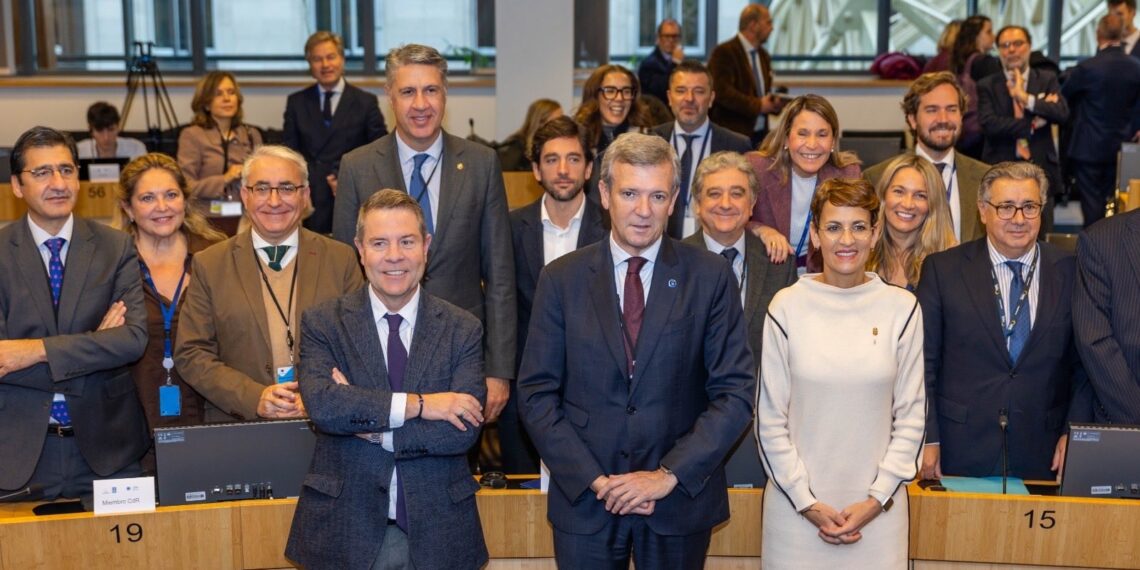
<h6><strong>Ane Barcos</strong></h6> <h4><strong>The Spanish delegation to the European Committee of the Regions (CoR) held a meeting in Brussels on Wednesday to discuss the ongoing negotiations for the next Multiannual Financial Framework (MFF) 2028-2034. At the meeting, representatives of the autonomous communities and local entities expressed their rejection of the current proposal, pointing to the lack of effective participation in the management of European funds and warning of the risk that the new budgetary framework will favor centralization at the expense of territorial cohesion.</strong></h4> The meeting, organized by the Galician government, was attended by representatives of the Spanish autonomous communities and local entities, Members of the European Parliament from the People's Party and the Spanish Socialist Workers' Party, as well as the Spanish Ambassador and Permanent Representative to the European Union, Marcos Alonso. The meeting, held to share the positions and concerns of the autonomous communities regarding the new architecture of the Multiannual Financial Framework (MFF), resulted in the ‘Galicia’ Declaration, a document adopted on October 21 at an extraordinary meeting of the Spanish delegation to the Committee of the Regions (CoR) in Santiago de Compostela. Local and regional leaders criticized the lack of active participation by the autonomous communities in the planning and management of European funds. Their concern is that decisions on the distribution of these funds will be centralized, without taking into account the perspectives and specific needs of the regions and local authorities. The President of the Xunta de Galicia, Alfonso Rueda, emphasized that the autonomous communities are the main implementers of a significant portion of European funds, noting that “we are the ones who implement the funds very effectively.” Rueda advocated for greater regional involvement in the decision-making process, urging that the central government not be the sole decision-maker. For his part, the president of Castilla-La Mancha, Emiliano García-Page, advocated for the creation of a national working protocol to ensure that the distribution of European funds is carried out in a “transparent” and consensual manner among the country's main political forces. García-Page emphasized that if solutions do not come from the European Commission, Spain will have to find its own mechanisms to address the needs of its regions. The president of the Government of Navarre, María Chivite, warned of the risk that the regions could lose “influence and decision-making and management capacity” under the new budgetary framework. Chivite reiterated the need for “multi-level governance,” in which the autonomous communities play an active role in decision-making. In this regard, she stressed that a distancing from European policies could generate disaffection among citizens toward the European project, since the perception that funds and programs are not reaching the territories adequately could undermine trust in the European Union. One of the main demands of the participants was the allocation of specific budgets for each autonomous community, in order to adapt the management of funds to the particular needs and characteristics of each region. The president of the Xunta de Galicia, Alfonso Rueda, insisted that it is necessary to ensure that “cohesion is maintained” and that clear and precise amounts are established regarding the funds available to each autonomous community. Rueda stressed that the distribution of funds should not be left to the discretion of each state, as this could generate inequalities in the allocation of resources. <h5><strong>Defending the CAP and CFP</strong></h5> During the meeting, the importance of maintaining funding for the Common Agricultural Policy (CAP) and the Common Fisheries Policy (CFP) was emphasized, given the growing concern about the European Union's food sovereignty. Rueda warned that cuts to CAP and CFP funding would be "devastating" for Europe's fishing regions, opening the door to imports from third countries with laxer environmental regulations. Similarly, the President of Andalusia and Vice-President of the European Committee of the Regions, Juan Manuel Moreno Bonilla, stressed that while increased investment in digital, technological, and defensive security is important, the agricultural, livestock, and fisheries sectors must also be treated fairly to ensure food sovereignty. Participants also called for improvements to energy transmission networks to facilitate the energy transition and ensure that renewable energy projects generate local wealth. It was proposed that at least 50% of new renewable energy generation be reserved for local industry, which would maximize the economic impact of clean energy investments in the regions. Rueda called for unity among Spain's main political parties, highlighting that both the People's Party (PP) and the Spanish Socialist Workers' Party (PSOE) wield significant power in the European Parliament. "Europe is very large, with many differences, but there are also common interests," he noted. Despite the anticipated difficulties, Rueda expressed his determination to continue pressing for the concerns of Spain's regions to be heard and taken into account in the new Multiannual Financial Framework.