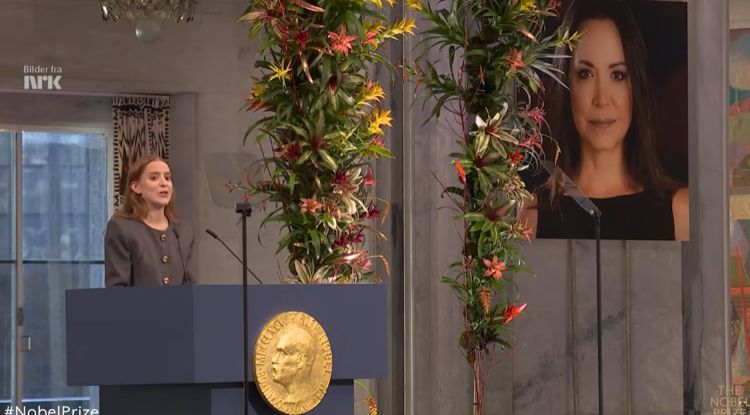
<h6><strong>Eduardo González</strong></h6> <h4><strong>The awarding of the Nobel Peace Prize to Venezuelan opposition leader María Corina Machado, held this Wednesday, December 10, in Oslo, has generated another heated confrontation between the People's Party (PP), which accused the Government of being “closer” to Venezuelan President Nicolás Maduro than to Machado, and Foreign Minister José Manuel Albares, who responded that fellow opposition figures Leopoldo López and Edmundo González “are free in Madrid and not detained in Caracas thanks to this Government.”</strong></h4> “Today is a great day for freedom in the world. María Corina Machado, defender of human rights and freedoms, receives the Nobel Prize, and the Government doesn't seem very happy,” stated PP deputy Carlos Rojas before the plenary session of the Lower House. The Norwegian Nobel Committee awarded the prize to María Corina Machado on Wednesday. Although she was able to fly to Oslo, she did not arrive in time to attend the ceremony. For this reason, she was represented by her daughter, Ana Corina Sosa Machado, who delivered a speech on her mother's behalf to the Latin American right-wing leaders attending the event, presided over by King Harald and Queen Sonja of Norway. “You seem closer to the dictator than to the Nobel Prize, and that is regrettable,” continued Carlos Rojas. “Spain has had a reputation in Latin America for fighting for human rights, which you have eroded with your government, and you will have to answer for this when Maduro leaves,” Rojas warned. “You speak of Venezuela as if you were directing Spain's foreign policy in Venezuela,” but “Zapatero directs it, everyone knows that,” the PP deputy stated, referring to former Prime Minister José Luis Rodríguez Zapatero and his mediation efforts in Venezuela. For his part, Carlos Floriano, of the People's Party (PP), stated during his address to the plenary session that, “at this very hour, as we are holding this debate, preparations are being finalized for the awarding of the Nobel Peace Prize to María Corina Machado, a generous, courageous, Hispanic woman and a role model for democrats worldwide, whom the Spanish government has been unable to congratulate, I don't know if it's because she is a woman, because she is Hispanic, or because she is a democratic icon.” “How can they congratulate María Corina Machado when they are incapable of calling what Venezuelans are suffering a dictatorship? They are incapable of calling a coup leader like Maduro, responsible for the repression, misery, and exile of millions of Venezuelans, a narco-dictator?” he denounced. “Don’t talk to us about a Venezuelan solution,” warned Floriano, who described the proposals for dialogue between the regime and the opposition as “oxygen lifelines for a tyrant, always promoted by Zapatero, who is in charge of giving oxygen to the narco-dictatorship.” <h5><strong>Albares</strong></h5> In his response, Albares asserted that, in other countries, “everyone applauds the foreign policy positions that are upholding Europe’s dignity in Palestine and the consistency we maintain with our positions on Ukraine.” “Only in recent years, on two occasions, has Spain upheld Europe’s dignity: with the withdrawal from Afghanistan and all the European collaborators who passed through here, through the Torrejón air base, and by recognizing and leading the charge in recognizing the State of Palestine. That is what Spain is known for abroad,” he affirmed. “Never before in our democracy have Spain’s positions carried so much weight abroad, nor has the consistency of our foreign policy positions received so much applause,” he insisted. “And you were talking about Venezuela,” Albares continued, addressing Rojas. “We are doing things for Venezuela; we are trying to unite Venezuelans, unlike you, who are trying to import the division of Venezuelans to Spain,” he asserted. “120,000 Venezuelans have protected status here, including Leopoldo López and Edmundo González, who thanks to this government are free in Madrid and not detained in Caracas,” the minister stated. “Of course I think it’s fine that María Corina Machado is being awarded the Nobel Prize,” Albares later stated in response to Floriano. “But you and we have opposing views on what Spain’s role in Venezuela should be. We work to unite Venezuelans, and you work to try to import the division of Venezuelans to Spain. You only use the Venezuelan people to try to divide Spaniards,” he denounced. “Stop using the Venezuelan people for your petty politicking,” because “you, more than a Spanish party, seem like a Venezuelan party,” he warned. “We have condemned all human rights violations, restrictions on public freedoms, and arbitrary detentions in Venezuela. We were the first country in the world not to recognize the July 28, 2024 elections, and we have led the way in making this the common position of the European Union. We were the first to demand the presentation of the tally sheets from all polling stations in Venezuela. Therefore, ladies and gentlemen, you talk the talk, and we take action,” he concluded. <h5><strong>Nobel Prize</strong></h5> On October 10, the Norwegian Nobel Committee announced the awarding of the 2025 Nobel Peace Prize to María Corina Machado, leader of the democratic movement in Venezuela, for “her tireless work in promoting the democratic rights of the Venezuelan people and for her struggle to achieve a just and peaceful transition from dictatorship to democracy.” The only reaction from the Spanish government came from the Minister of the Presidency, Félix Bolaños, who recalled that Spain “worked intensely” to secure Corina Machado’s release “during her time in prison.” A week later, the Popular Parliamentary Group demanded that the government express “its satisfaction” with the awarding of the 2025 Nobel Peace Prize to María Corina Machado, “a symbol of the defense of freedom, human rights, and democracy in Venezuela,” and denounced the Executive’s “shameful silence” on this matter, which “has a face and a name: José Luis Rodríguez Zapatero.”