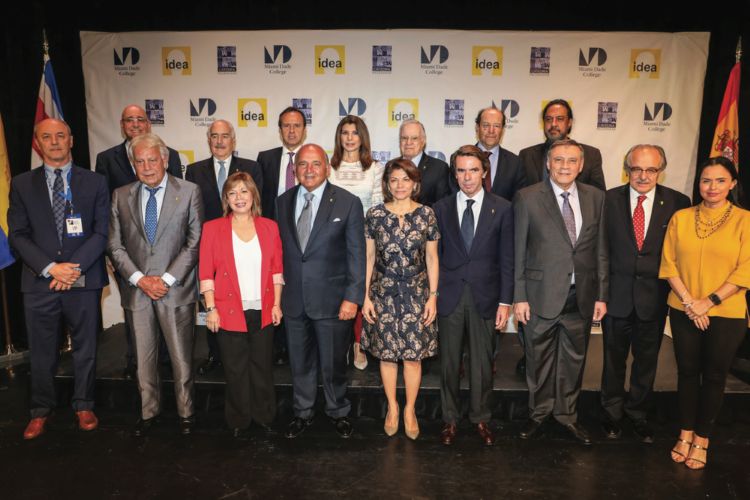
<h6><strong>Eduardo González</strong></h6> <h4><strong>The Socialist Parliamentary Group has urged the Government to reaffirm "Spain's commitment to strengthening institutional systems and democratic processes in Latin America" and to "prioritize in its foreign policy towards Latin America an approach based on institutional strengthening, the defense of democracy, and human rights."</strong></h4> In a non-binding motion registered on November 17 for debate in the Foreign Affairs Committee, the Socialist Group recalls that "Latin America is a constant in Spain's identity and foreign policy" and that "historical, political, cultural, scientific, educational, and business ties constitute the basis of this bi-regional cooperation." "This commitment must continue to drive a progressive agenda, focused on sustainable development, human rights, and regional integration—key elements for generating opportunities for growth and mutual benefit," it continues. “Unfortunately,” laments the PSOE (Spanish Socialist Workers' Party), “we are going through an era marked by the crisis of democracy,” and the Ibero-American region “is no stranger to this phenomenon.” “We are seeing how populist trends are being adopted in the Ibero-American region, which could pose a greater risk to its citizens,” the Socialist Group continues. “In Ibero-America, the fear of authoritarian regimes and governments is a shared concern rooted in its recent history,” and currently, “factors such as armed conflicts, growing geopolitical tensions, the progressive weakening of the system of international and regional organizations and bodies, as well as the geopolitical importance of new economic, technological, and commercial actors, whose particular interests sometimes prevail over public policies aimed at the common good, hinder the consolidation of democracy, in the face of a citizenry that is increasingly disconnected and whose expectations are ever more frustrated,” warns the PSOE. “These challenges are compounded by the loss or restriction of individual freedoms, the violation of the principle of separation of powers, the balance of power, and the discrediting and weakening of institutions and the judicial system. These, along with structural problems such as corruption, insecurity, persistent inequalities, and the underground economy, hinder one of the objectives of the majority of the region's residents: to live in a democracy,” the statement continues. “Furthermore, in recent years, we have witnessed the consolidation of conservative ideological networks that, from private spaces such as foundations or forums of former presidents, seek to influence the international positioning of the Ibero-American region,” the Socialist Group denounces. These networks “have even proposed new ways of conducting politics in angry, dissatisfied, and misinformed societies, dominated by social media and radicalization, which on too many occasions have blurred the thin line between truth and conspiracy theory, with the consequent deterioration of democracy, the emptying of the public sphere, and the decline of public services,” it continues. “In this context, these interferences could pose a risk to the quality of the Spanish government’s relations with the other governments in the region,” asserts the party of President Pedro Sánchez. “Therefore, it is necessary to reaffirm the role of Congress as the foundation of a respectful, institutional diplomacy aligned with democratic principles and values,” it adds. The Socialist Group makes no mention of the issue. The most active forum of former presidents in the region at the moment is the IDEA Group (Democratic Initiative of Spain and the Americas), whose members include, among others, former Spanish Prime Ministers José María Aznar and Felipe González. According to its website, the group addresses “the paths and means that allow for the establishment of democracy where it does not exist or its reconstitution where it has deteriorated, and promote its defense and respect by the governments where it is established.” Former presidents Óscar Arias, Felipe Calderón, Fernando H. Cardoso, Laura Chinchilla, Vicente Fox, Luis Alberto Lacalle, Hipólito Mejía, Gustavo Noboa, Andrés Pastrana, Julio María Sanguinetti, Alejandro Toledo, and Álvaro Uribe, among others, are also linked to the IDEA Group. For all these reasons, the non-binding resolution urges the Government to “reaffirm Spain’s commitment to strengthening institutional systems and democratic processes in Latin America, in full respect for their domestic legal systems and international law” and to “prioritize in its foreign policy toward Latin America an approach based on institutional strengthening, the defense of democracy, and human rights.”