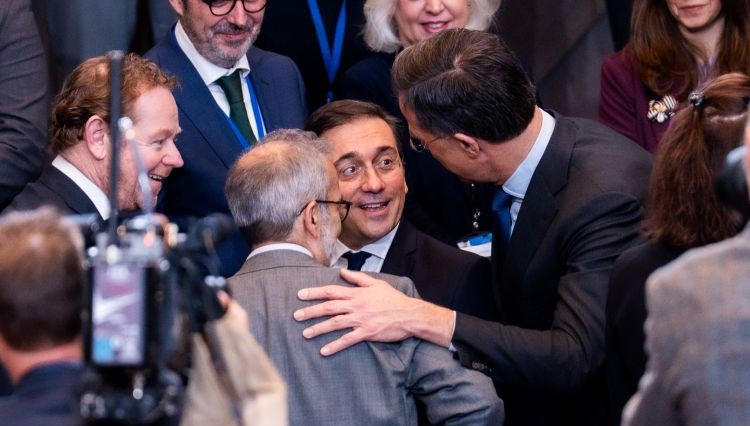
<h6><strong>Eduardo González</strong></h6> <h4><strong>Foreign Minister José Manuel Albares warned his NATO counterparts on Wednesday, December 3, of the need to continue supporting Ukraine in defending itself against Russian aggression and to increase pressure on Russia to end the war, because “a war of aggression cannot be rewarded.”</strong></h4> Albares participated in the NATO Foreign Ministers' meeting in Brussels, held one day after Russian President Vladimir Putin warned that if Europe “wants a war with Russia,” his country “will be prepared.” This threat was issued by the Russian leader shortly before the start of new negotiations in the Kremlin on the peace plan for Ukraine between the Russian government and a US delegation. In response, NATO Secretary General Mark Rutte asserted on Wednesday, at the press conference following the ministerial meeting, that the Alliance “is a defensive alliance and will remain so,” but warned that it is “ready and willing to do whatever is necessary to protect our one billion people and secure our territory.” “I’m not going to react to everything Putin says. We’ve seen him in military fatigues, dressed like a soldier on the front lines, but not on the front lines. He was quite far from the front lines,” the Dutch leader declared earlier upon arriving at the meeting. During the ministerial meeting, which was also attended by his Ukrainian counterpart, Andriy Sybiha, and the High Representative of the European Union, Kakha Kallas, Albares affirmed that “Spain and Europe, and, of course, Ukraine, want peace, and we will continue to support all efforts to move towards it,” but that this peace must be “credible, just, and lasting” and cannot be a reward for the aggressor or a mere interlude between wars. “A war of aggression cannot be rewarded because Europe, our security, Euro-Atlantic security, the world, would be more insecure,” he declared upon arriving at the meeting. Likewise, according to a press release from the Ministry of Foreign Affairs, Albares emphasized the role of the United States as Europe’s “historical natural ally,” whose contribution is “essential” to achieving peace in Ukraine, a peace that, he warned, “is linked to the security of Europe and the entire Euro-Atlantic area, and therefore all allies must be involved in it.” “Every peace effort, including the one undertaken by the President of the United States, if it is aimed at achieving a just and lasting peace, Spain will work in favor of it and will support it,” he assured reporters. “However, there are also red lines, and that is that no decisions can be made about Ukraine, about its territorial integrity, about its sovereignty, about the decisions of international organizations in which a free and sovereign Ukraine may participate in the future, without Ukraine’s voice,” he warned. “Nor can decisions be made about Europe, the European Union, the international organizations in which Europeans participate, or European security—because everything concerning Ukraine is closely linked to European security—without Europeans at the table,” he added. Albares recalled that NATO is an alliance of democracies and warned that Russia poses a threat to both them and Ukrainian democracy. Specifically, the minister referred to Russian disinformation campaigns, its hybrid actions, and its destabilizing efforts throughout the European sphere, including the Southern Neighbourhood. <h5><strong>Spain's role in NATO</strong></h5> Furthermore, following the controversy generated by the Pedro Sánchez government's refusal to increase defense spending to five percent of GDP during the NATO Summit last June in The Hague, the minister highlighted Spain's contribution to NATO deterrence and defense, citing the deployment of its Armed Forces on the Alliance's Eastern Flank and in the mission in Iraq. He also affirmed that the Spanish government advocates a comprehensive vision of security, which necessarily includes prevention and response to crisis situations, strengthening deterrence and defense, economic security, and action in the energy, climate, and health sectors, in the face of terrorism and hybrid threats, including disinformation. Albares took advantage of the meeting to meet with his counterparts from Germany, Johann Wadephul; Poland, Radosław Sikorski; Canada, Anita Anand; and Lithuania, Kęstutis Budrys. and Norway's Espen Barth, to whom he conveyed Spain's commitment to Ukraine and Euro-Atlantic security, as well as relevant aspects of the bilateral relationship. He also discussed Euro-Atlantic security with the head of the US delegation, Christopher Landau.