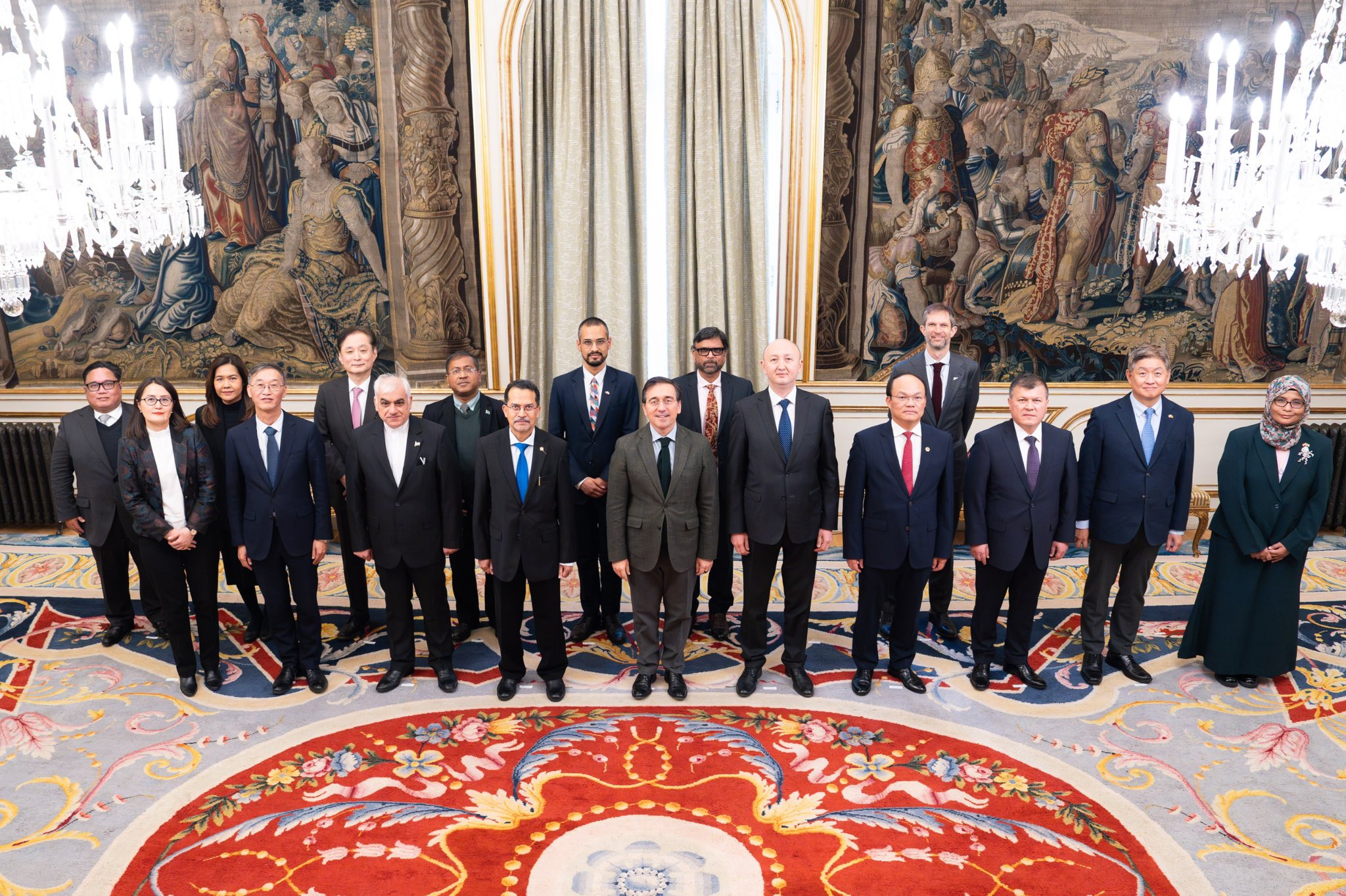
<h6><strong>Eduardo González</strong></h6> <h4><strong>Foreign Minister José Manuel Albares met on Tuesday with the Asian ambassadors accredited to Spain, to whom he outlined the upcoming Spanish Asia-Pacific Strategy, which he will present "soon."</strong></h4> "Spain's global foreign policy, with its own distinct identity, is working to strengthen relations with the countries of the Asia-Pacific region, a key region," the minister wrote on social media after the meeting, which took place at the Ministry's headquarters in the Palacio de Viana. "I discussed the Spanish Asia-Pacific Strategy with the ambassadors of this region to Spain, which I will present soon," he added. Last January, the minister announced during the IX Conference of Ambassadors in Madrid that the Ministry was beginning "the development of the new strategy for Asia." “The Indo-Pacific region is progressively consolidating itself as the new center of gravity of international relations, both from an economic standpoint, with three of the world’s five largest economies (China, Japan, and India), and from a political, with the world’s largest democracy (India), and security perspective,” and, in this regional context, “Spain must assume a more prominent role in the region. This intention is clear and a priority,” he added before the Spanish ambassadors accredited around the world. The Foreign Action Strategy 2025-2028, announced in June of this year, highlights that Asia-Pacific is “increasingly the center of gravity of international relations, with a rising geopolitical and economic role that will endure over the next four years” and, within this framework, the Government’s objective is “to forge a closer partnership with the main powers of Asia-Pacific, understood as an essential element for Spain’s global projection, its economic security, and its commitment to an open, rules-based international order.” “Spain will continue to contribute to relations founded on respect for international law and the importance of preserving stability and security in this key region,” it adds. More specifically, the strategy envisions Japan and the Republic of Korea remaining “strategic partners for Spain” in areas such as investment, collaboration in sectors like renewable energy, automotive and digitalization, security and defense, and the promotion of Spanish language and culture. Furthermore, it proposes “an ambitious bilateral agenda with China, deepening the comprehensive strategic partnership that is entering its third decade” and advocating for “EU-China relations in which differences do not undermine the need for a positive and cooperative agenda in the face of global challenges.” Regarding South Asia, the strategy states that “India will receive priority attention in accordance with its growing weight in the international order” and that Spain will contribute “to strengthening the EU-India strategic partnership and to concluding negotiations to achieve free trade agreements, investment protection, and geographical indications.” Furthermore, Spain will continue to promote the defense of the rights of women and girls in Afghanistan, strengthen relations with ASEAN “through the signing of the Treaty of Friendship and Cooperation, which in the medium term will allow it to be elevated to the status of cooperation partner, like other European countries,” and reinforce political and economic dialogue with the Southeast Asian region, especially with Indonesia and Vietnam. In 2022, the Ministry appointed an Ambassador on Special Mission for the Indo-Pacific tasked with defending, within the priorities of the European Strategy, the interests of our country and reinforcing the leading role of Spain and the EU in the region.