
Eduardo González
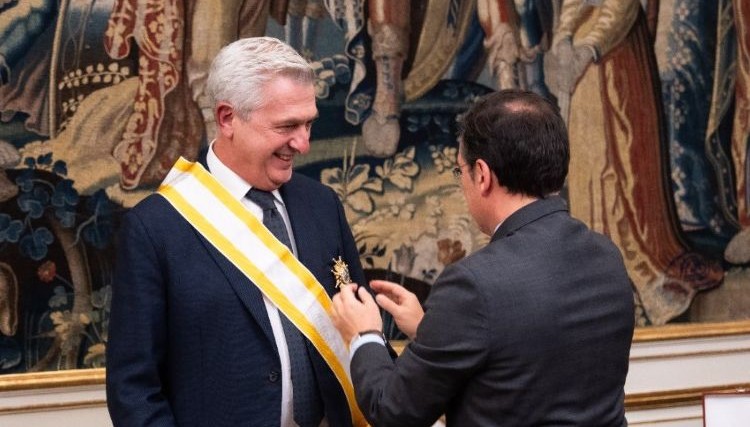
Foreign Minister José Manuel Albares presented Filippo Grandi with the Grand Cross of the Order of Isabella the Catholic on Monday, December 1, just one month before the end of his term as United Nations High Commissioner for Refugees (UNHCR).
“Spain supports the work of UNHCR and its High Commissioner, Filippo Grandi, for the protection of refugees worldwide,” Albares wrote on social media. “The values he defends—multilateralism, solidarity, human dignity, and respect for international law—are our own,” he continued. “Today we have presented him with the Grand Cross of the Order of Isabella the Catholic.”
Grandi was previously received by Prime Minister Pedro Sánchez at the Moncloa Palace complex. “I thanked Filippo Grandi for his ten years of exemplary work at UNHCR and his defense of multilateralism,” the Prime Minister wrote on social media. “UNHCR is a priority humanitarian partner for Spain,” he stated. “We will continue to strengthen our relationship, combat xenophobic rhetoric, and support refugees,” he affirmed.
The UNHCR chief also met with the Minister of the Interior, Fernando Grande-Marlaska. The meeting was attended by the Undersecretary of the Ministry, Susana Crisóstomo, and the Directors General for International Relations and Immigration, Elena Garzón, and for International Protection, Octavio Rivera.
Grandi himself reported on his meetings with Sánchez, Albares, and Grande-Marlaska, during his “last visit to Madrid with UNHCR.” “Spain continues to be a benchmark of solidarity with refugees,” he asserted on social media. “At a time of global challenges, its multilateral commitment is more important than ever,” he added.
On July 22, King Felipe VI, at the proposal of Minister Albares and following deliberation by the Council of Ministers, signed the decree awarding the Grand Cross of the Order of Isabella the Catholic to Filippo Grandi “in recognition of his merits and the circumstances surrounding” him.
Filippo Grandi, born in Milan in 1957, is the eleventh United Nations High Commissioner for Refugees. He was elected by the UN General Assembly on January 1, 2016, for a five-year term (to succeed the current UN Secretary-General, António Guterres) and subsequently re-elected twice. His term will conclude on December 31, 2025.
Grandi has worked in the humanitarian and refugee sector for over 30 years. From 2010 to 2014, he served as Commissioner-General of the UN Relief and Works Agency for Palestine Refugees (UNRWA). Specifically, the Government awarded the Grand Cross of the Order of Isabella the Catholic to Philippe Lazzarini, Commissioner-General of the United Nations Relief and Works Agency for Palestine Refugees in the Near East (UNRWA), in April 2024.
Prior to assuming this position, Lazzarini served as Deputy Commissioner-General of UNRWA from 2005 and was Deputy Special Representative of the Secretary-General for Afghanistan. He has also collaborated with non-governmental organizations and worked in UNHCR offices in Africa, Asia, the Middle East, and at its headquarters in Geneva.
The Order of Isabella the Catholic is, hierarchically, the second highest distinction in Spain, after the Order of Charles III, but is considered the most prestigious in the field of foreign relations. Established by King Ferdinand VII on March 14, 1815, as the “Royal and American Order of Isabella the Catholic,” with the aim of “rewarding unwavering loyalty and merits acquired in favor of the prosperity of those territories,” it was reorganized in 1847, when it became known simply as the “Royal Order of Isabella the Catholic.” According to its Regulations, this new name distinguishes “extraordinary acts of a civil nature, performed by Spanish and foreign persons, that benefit the Nation or contribute significantly to fostering friendly relations and cooperation between the Spanish Nation and the rest of the International Community.”
The King serves as Grand Master of the Order, and the Minister of Foreign Affairs, as Grand Chancellor, submits proposals for the awarding of the Order’s higher degrees to the Council of Ministers, which grants them by Royal Decree. More than 70,000 people worldwide have this distinction in one of its various levels.