
The Diplomat
The Minister of Foreign Affairs, José Manuel Albares, admitted yesterday that the professionalization of Spanish aid workers is “a pending subjet” and, therefore, pledged to make it “one of the pillars” of the reform of the Cooperation system and the new law on which the Government is currently working.
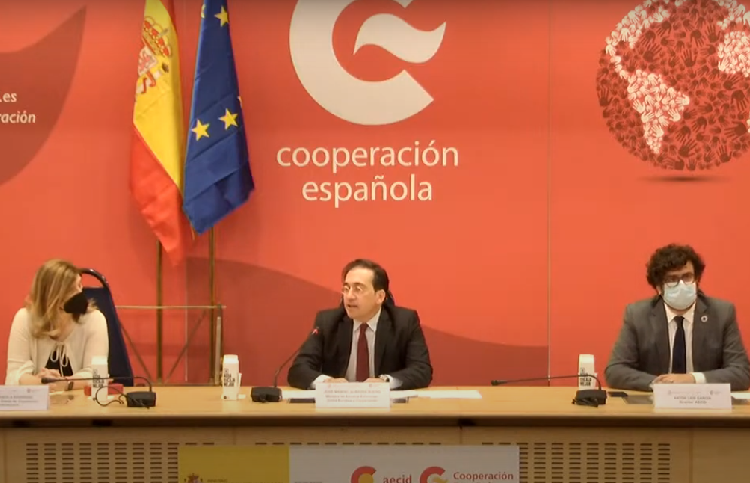
“We need to reform the development cooperation system to adapt it to the new international reality two decades after the 1998 law,” said the minister during the inauguration of the Spanish Cooperation Forum 2021, held at the headquarters of the Spanish Agency for International Development Cooperation (AECID) in Madrid on the occasion of the commemoration of the Aid Workers’ Day, established in 2006 by the United Nations.
“The professionalization of the career of development workers is a pending subject and we are going to try to ensure that it does not remain pending”, and, therefore, “one of the most urgent pillars of the reform” of the Spanish Cooperation system must be “to design for the first time a professional career, valued, modern and comparable with the countries of our environment that have a real commitment to the sector”, continued Albares.
According to the minister, development cooperation is a “pillar of Spain’s external action” and, therefore, “it must be, it can only be, a public policy of the State and of all the entities and levels of the Administration”. To this end, he added, it is necessary to “strengthen the backbone” of Cooperation, the AECID, because “only in this way will we be able to live up to the real solidarity of our society and the work of aid workers”. That is the objective of the reform initiated by his predecessor, Arancha González Laya, and in which the Government “is working intensely” to achieve, “with the widest possible parliamentary support”, a cooperation system that is “modern and efficient and that has the necessary capacities”, he added.
The minister also assured that the government “is not going to leave any of our Afghan collaborators behind, not even those of the Spanish cooperation” and that is why it continues to look for the safest ways to get them out of the country. The Kabul airport is no longer a safe way because it is controlled by the Taliban, “but we will find other ways”, he continued. “It is my personal commitment and I will work on it in the coming weeks” because it is a “responsibility and an obligation” to the Afghans who collaborated with AECID, with the Spanish troops and with the Embassy.
At the same event, the newly appointed Secretary of State for International Cooperation, Pilar Cancela, said that one of her main challenges is to “strengthen the Spanish Cooperation system and, above all, the conditions and professional careers of our aid workers”. “It will not be easy, the context is very difficult, since we are in an economic and social crisis, but we will try to put on the table all the efforts and all the will to work to achieve it”, she admitted.
For his part, the also recently appointed director of the AECID, Antón Leis, recalled that in his “first days at the AECID” he has had to “manage the Spanish aid sent to alleviate the consequences of the earthquake in Haiti”, which has allowed him to “see the great professionalism of the staff of this house”.